MiniNEC x64 (64 bit Win10/11 Procedural MiniNEC with Plot and CSV outputs)
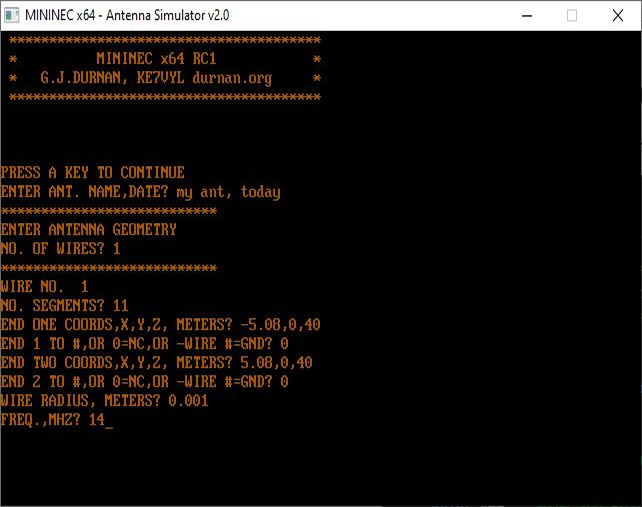
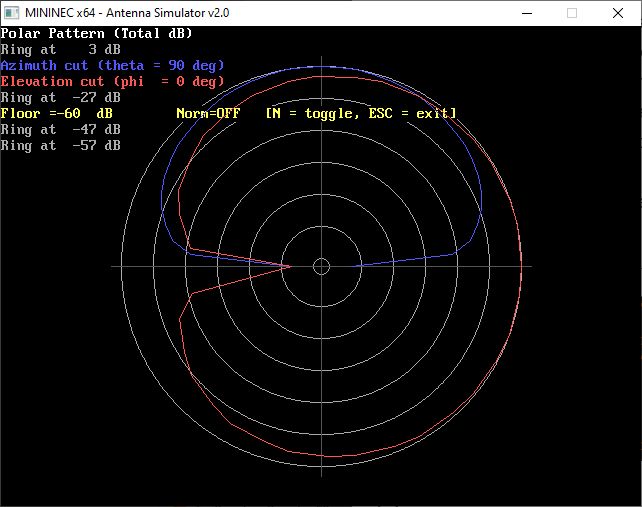
This is further developent of a MiniNEC port to QB45 I did many years ago. QB64 is strict although still case insensitive - it's not been an easy port. Many dozens of compilations so far. Based on MiniNEC 2 its over a 1100 lines at this point. If you wish to give it a go please do however much testing and V&V is needed to determine its shortfalls. As I have time I will progress it. A pretty complete rewrite - it's purely procedural with not a goto in sight and the variables are named for their equation function. Currents are pushed to an external CSV file with x,y,z with the anticipation we will end up with 3D plots out of MiniNEC x64. I've added a new graphical radiation plot at the end and calibrated the output against a 20m dipole. Likewise, radiation plots are traditionally done by summing elements at various observation points around an arc. It's been kept for now, but it makes sense to rip that out. There's even an undefined subscript in the pattern code which indicates a first version of MiniNEC was Fortran - an interesting find - if you know this drop a note. But it looks that way. Radiation plots are also pushed out in a CSV of by angle, E, H, TotdB. I see several versions here - this one kind of like the old fashioned one for those who like that, one with an input deck, and a .dll
What is MiniNEC?
MiniNEC is a computational tool for simulating and analyzing wire-based antennas using the Method of Moments (MoM), a numerical technique in electromagnetics. It models antenna performance by solving integral equations for current distributions on wire structures, enabling predictions of radiation patterns, impedance, gain, and efficiency. Originally designed for minicomputers and early PCs, MiniNEC is lightweight, making it ideal for hobbyists (e.g., ham radio operators), educators, and quick prototyping in broadcast and amateur radio applications. It supports simple wire geometries like dipoles, loops, Yagis, and helices, with ground effects and loading options.
History of MiniNEC
MiniNEC traces its roots to the Numerical Electromagnetics Code (NEC), developed in the 1970s at Lawrence Livermore National Laboratory for the U.S. Navy to model ship antennas. NEC used MoM for full-scale simulations but required mainframes.
In the early 1980s, as personal computers emerged, Dr. John W. Rockway and colleagues at the Naval Ocean Systems Center (NOSC) adapted NEC for smaller systems, creating MiniNEC in 1981. It simplified NEC's kernel for wire antennas, reducing computational demands while retaining core accuracy. Released publicly, it became popular among radio amateurs via bulletin boards and floppy disks.
By the mid-1980s, MiniNEC influenced tools like EZNEC and 4NEC2. It evolved with PC hardware, adding features like better ground modeling. Though superseded by full NEC variants, MiniNEC remains valued for its simplicity and educational use, with modern ports (e.g., x64 builds) ensuring compatibility.
Various Versions Over the Years
- MiniNEC 1.0 (1981): Initial release for minicomputers/early PCs; basic wire MoM with limited segments (e.g., 20-50 wires).
- MiniNEC 2.0 (1983): Improved kernel for better convergence; added ground plane options and basic optimization.
- MiniNEC 3.0 (1985): DOS-based; supported more segments (up to 100); included sample models for ham antennas.
- MiniNEC Professional (1990s): Commercial variants with GUI (e.g., from Nittany Scientific); integrated plotting tools.
- Modern Ports (2000s–2020s): Open-source forks like MiniNEC Broadcast; x64 builds for Windows/Linux (e.g., via Fortran-to-C ports); integrations with MATLAB/Python.
- MiniNEC x64 (Recent): 64-bit versions for large models; enhanced for multi-core CPUs; community-maintained on GitHub-like platforms.
Versions diverged into free (open-source) and paid (with advanced features like NEC-4 kernels). Today, it's often bundled in suites like AutoEZ or used in education for MoM basics.
Basic Flowchart of MiniNEC Operation
Below is a simple text-based flowchart illustrating MiniNEC's core workflow using the Method of Moments:
+---------------------+
| Define Geometry     |
| (Wires, segments,   |
|  sources, loads)    |
+---------------------+
           |
           v
+---------------------+
| Set Environment     |
| (Frequency, ground, |
|  materials)         |
+---------------------+
           |
           v
+---------------------+
| Build Impedance     |
| Matrix (Z-matrix)   |
| using MoM integrals |
+---------------------+
           |
           v
+---------------------+
| Solve for Currents  |
| (Invert Z-matrix    |
|  or LU decomposition|
+---------------------+
           |
           v
+---------------------+
| Compute Outputs     |
| (Patterns, gain,    |
|  impedance, SWR)    |
+---------------------+
           |
           v
+---------------------+
| Visualize/Export    |
| (Plots, files)      |
+---------------------+
This process iterates for sweeps (e.g., frequency scans). Computation time scales with segments cubed (O(N^3)), limiting model size.